11th Aug '23
/
4 comments

Sort Posts by Meta Box Group Sub Field in Bricks

This Pro tutorial provides the steps to order posts in Bricks by the value of a Number-type of sub field that is inside a Meta Box group.

Use case: Sort posts by year.

If the year field were not inside a group, it is straight forward to order by the field value:

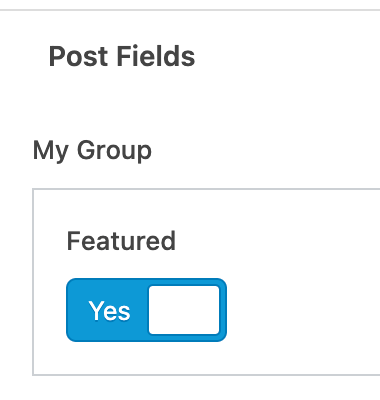
But if the field is inside a group like this:

there is no built-in way, that I know of, to set up ordering using the controls that Bricks provides in the editor.

What Bricks does provide however, is a set of excellent filter hooks for developers to modify most aspects of the output programmatically.

We shall use the bricks/query/result filter to intercept the query result by

  • getting the array of post objects in the result
  • getting the array of post IDs
  • sorting the above array using a custom comparison function
  • getting the array of post objects from the above sorted array of post IDs
  • setting the posts property of the result object to the above array of sorted post objects

to arrange the posts in the order of those that have the sub field populated in either ascending or descending order followed by the rest in the default date descending order.

Sample data from our test site:

Event 0:

Event 1: 2026

Event 2: 2023

Event 3: 2022

Event 7: 2040

(rest of the event entries have the field empty)

On the front end before implementing the tutorial:

On the front end after implementing the tutorial - with posts arranged by the Event Year sub field in descending order:

Step 1

Inside a Section's Container, add a Posts element or set up a query loop on a Block element.

Configure the query and set

Order by: Meta numeric value

If you are not editing a template that applies to the event CPT archive, set Post type to Events.

Add the following in child theme's functions.php or a code snippets plugin:

This is a BricksLabs Pro tutorial.

For full access login below or create your BricksLabs Pro account

Get access to all 633 Bricks code tutorials with BricksLabs Pro

Related Tutorials..

Pro
Nested Meta Box Query Loop Inside a CPT Query Loop in Bricks

Nested Meta Box Query Loop Inside a CPT Query Loop in Bricks

This Pro tutorial provides the steps for setting up a cloneable Meta Box group query inside a CPT query in Bricks. Scenario: CPT: course Meta…
Categories:
Pro
Meta Box Taxonomy Field’s Image Value in Posts

Meta Box Taxonomy Field’s Image Value in Posts

In a project I am currently working on, the requirement is to show the image of an "Image Advanced" type attached to a taxonomy in…
Categories:
Tags:
Pro
Dynamic Post-specific Templates in Bricks using Meta Box/ACF Select Field

Dynamic Post-specific Templates in Bricks using Meta Box/ACF Select Field

Update on 23 Aug 2023: Added steps for ACF. Bricks builder v1.8.4 introduced an pretty useful filter called bricks/active_templates that flew under the radar. This…
Pro
Conditionally outputting an element in a Query Loop based on date-type custom field

Conditionally outputting an element in a Query Loop based on date-type custom field

This Pro tutorial shows how to output an element in a Bricks' query loop only if the value of a date-type of custom field for…
Categories:
Pro
Filtering posts by a group field’s true / false field sub field value with ACF or Meta Box in Bricks

Filtering posts by a group field’s true / false field sub field value with ACF or Meta Box in Bricks

This Pro tutorial covers how posts of a Bricks query loop can be filtered to show only the ones whose true / false or checkbox…
Categories:
Tags:
Pro
Ordering Meta Box group rows by a sub field in Bricks

Ordering Meta Box group rows by a sub field in Bricks

In the BricksLabs Facebook group a user asks: Any idea how to set the sort order of a cloneable group in the query? In this…
Pro
Bricks Forms + Meta Box: Auto-Create Post Relationships on Form Submission

Bricks Forms + Meta Box: Auto-Create Post Relationships on Form Submission

How to link a Bricks post-creation form on a post to a newly created post of another post type using Meta Box relationship.